
 Image 1 of 4
 Image 2 of 4
 Image 3 of 4
 Image 4 of 4
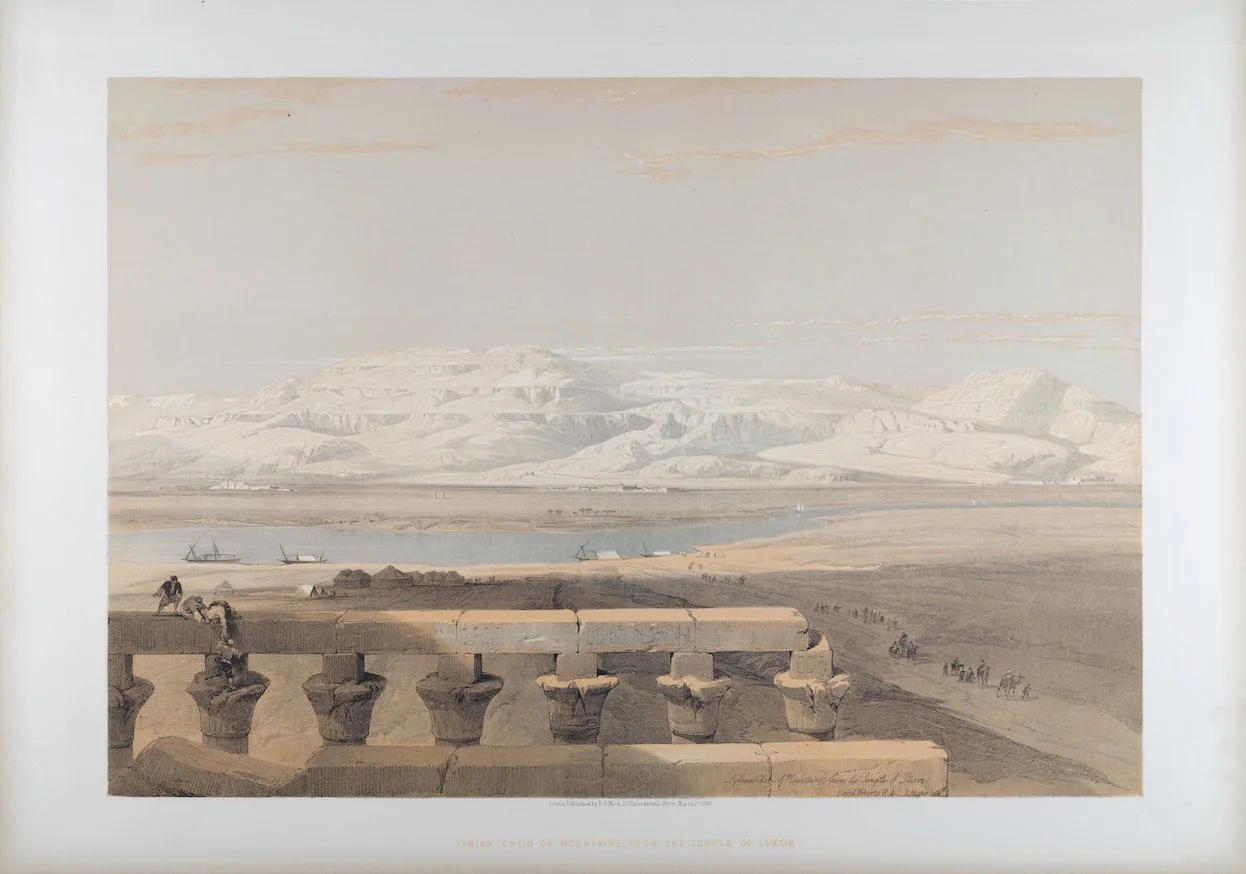
This lithograph depicts a panoramic landscape that shifts attention from monumental architecture to the vast natural setting of ancient Thebes. The viewpoint is taken from the Temple of Luxor, looking westward across the Nile toward the Libyan (Theban) hills. The mountains form a long, low, jagged ridge on the horizon, their pale limestone faces catching the strong Egyptian sun. Roberts renders them with subtle tonal gradations, suggesting both heat and distance. In the middle ground, the Nile plain stretches wide and luminous. Bands of cultivated green contrast with the arid desert beyond, emphasizing Egypt’s dramatic meeting of fertility and barrenness. The river itself often appears calm and reflective, dotted with small boats, reinforcing the sense of quiet continuity. A camel caravan is seen heading away from the river on the right. Egyptian men are seen climbing onto the stones of Luxor in the foreground on the right. The western hills held deep symbolic meaning in ancient Egypt, as they were associated with the realm of the dead, home to the Valley of the Kings and royal necropolis.
This duotone lithograph is printed on a sheet with wide margins. Overall the sheet measures 16.75" high and 23.88" wide. There are two faint spots in the right margin and a faint horizontal crease in the upper margin. None of this would be visible behind a mat at framing. The image portions of the print is in excellent condition.
The drawings and watercolors from Roberts' tour of the Holy Land and Egypt were collated together into folios and released over a seven year period by the publisher F.G. Moon from 20 Threadneedle Street London. This lithograph is from the Royal Subscription Edition (1842-1849) with only 500 copies produced per depiction. Louis Haghe (the Belgian engraver and friend of Roberts) worked on all of the lithographs for this series.
David Roberts (1796-1864) was born outside of Edinburgh, Scotland. At age 10 he became a house painter’s apprentice. He continued painting houses and eventually theater scenes in Edinburgh and then in London. His friend, J. M. W. Turner, recognized his artistic talent and encouraged him to become a full-time artist.
In 1839 Roberts traveled to Egypt and then in 1840, through the Holy Land, concluding in Jerusalem. Upon his return to England, F. G. Moon agreed to publish lithographs created by Louis Haghe from Robert’s sketches and watercolors. This publication was highly acclaimed and very popular for its esthetic quality, its historical and topographical accuracy, and Robert’s dramatic depiction of his scenes. Queen Victoria and Charles Dickens were among the subscribers who collected his works. Roberts' and Haghe’s duotone lithographs, often colored, remain extremely sought-after today and have been rising steadily in value.


