 Image 1 of 4
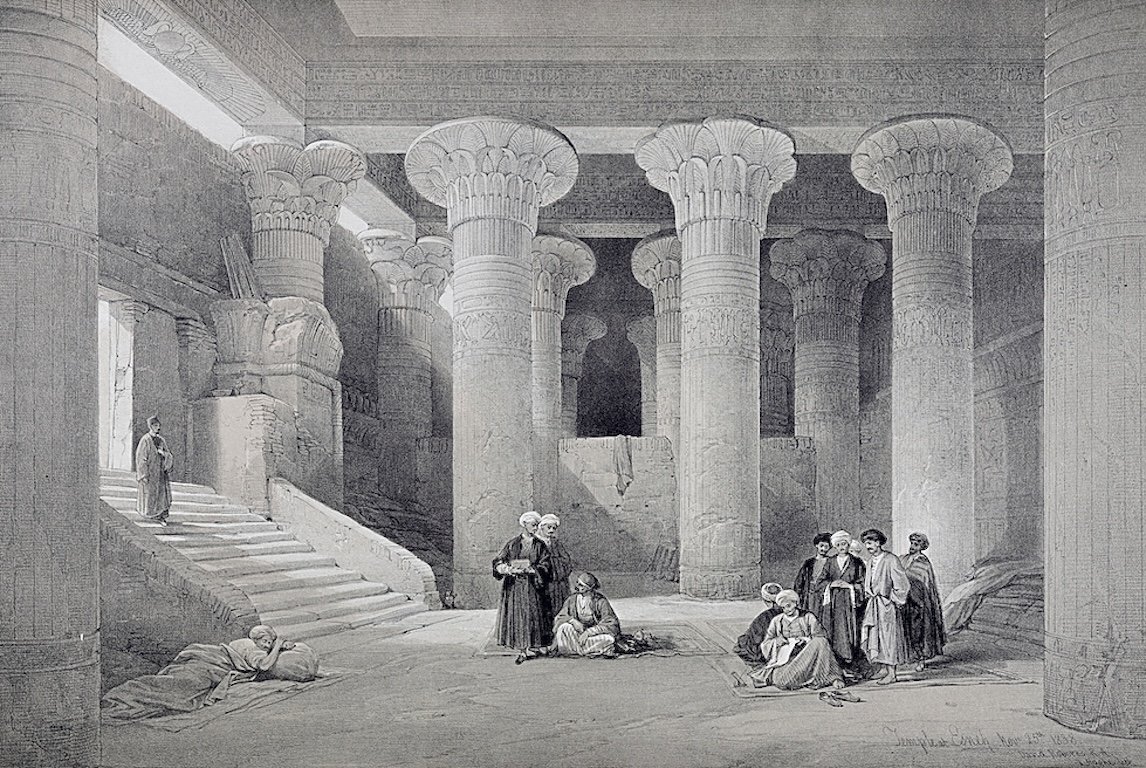 Image 2 of 4
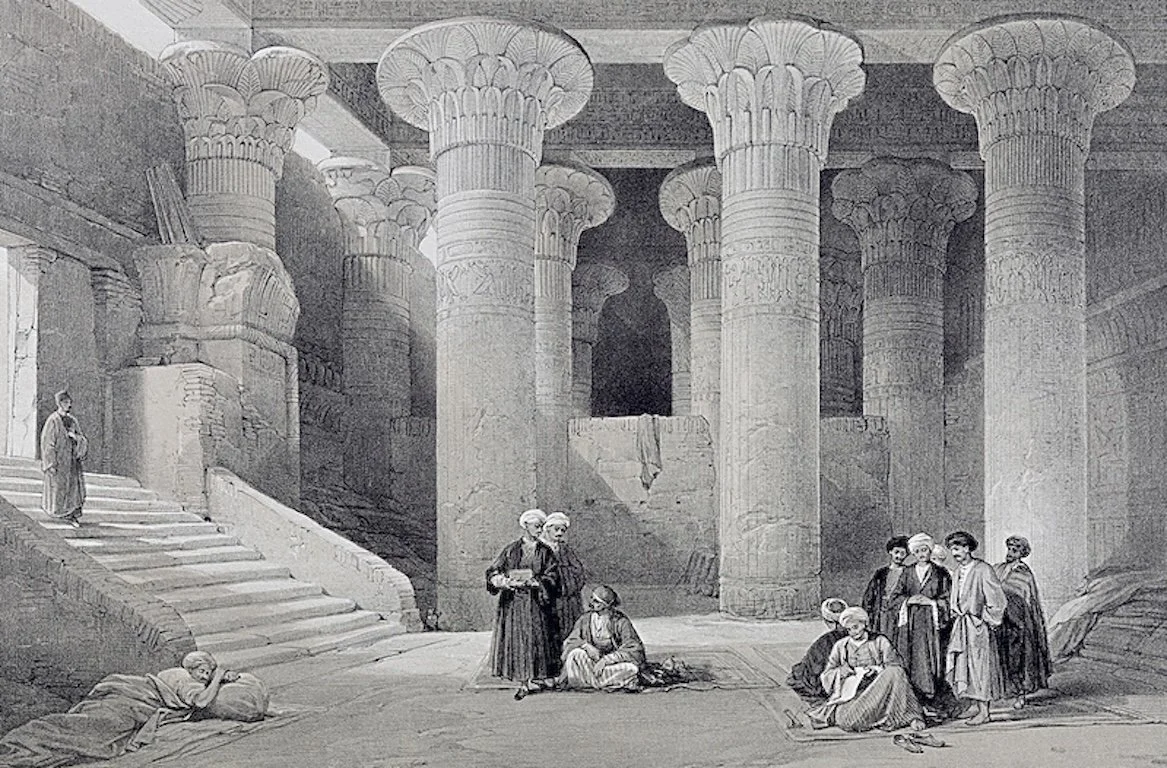 Image 3 of 4
 Image 4 of 4
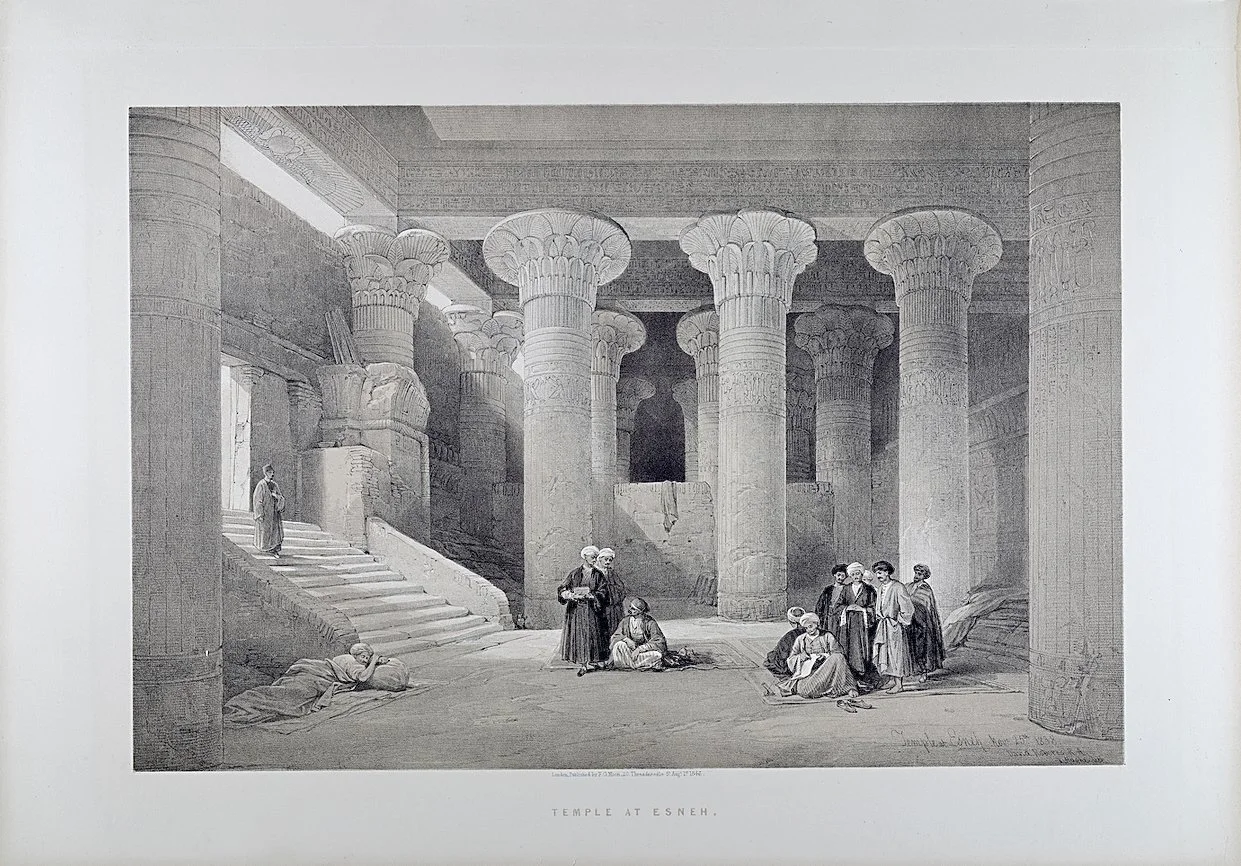
In this lithograph, Roberts depicts the impressive remains of the Temple of Khnum at Esna in the town of Esna, located on the west bank of the Nile south of Luxor. The monumental hypostyle hall dominates the scene. Roberts shows the temple’s massive stone columns with elaborate capitals and carved hieroglyphic inscriptions.
Roberts includes Egyptian men within the temple, including one sleeping on the left to convey daily life and provide scale against the enormous columns. Strong contrasts of light and shadow emphasize the height and solidity of the architecture while creating a dramatic, romantic atmosphere typical of Roberts’ travel imagery.
Like many of Roberts’ works, the image combines topographical accuracy with the picturesque aesthetic popular in 19th-century European art. The juxtaposition of ancient ruins and contemporary life highlights the sense of Egypt as a place where the past and present coexist.
The Temple at Esna was dedicated primarily to Khnum, a ram-headed deity believed to control the waters of the Nile and to create humans on a potter’s wheel. Worship of Khnum was particularly important in Upper Egypt, making Esna a significant regional religious center. Most of the surviving structure dates from the Ptolemaic and Roman periods (roughly 2nd century BCE to 3rd century CE). The temple’s hypostyle hall was completed under Roman emperors including Claudius and Vespasian. The temple is an important example of late Egyptian temple architecture, showing how traditional Egyptian religious building styles continued under Greek and Roman rule. The temple contains extensive hieroglyphic texts and astronomical inscriptions carved into its walls and ceilings. These inscriptions provide valuable information about religious rituals including local theology connected to Khnum, as well as ancient Egyptian cosmology and calendar systems.
Unlike many Egyptian temples located in isolated archaeological zones, the Temple of Esna survived in the middle of a living town. For centuries, much of the structure was buried under accumulated debris and surrounded by houses and markets. Roberts’ lithograph captures this unusual situation, showing the monument integrated into everyday urban life.
This duotone lithograph is printed on a sheet with wide margins. Overall the sheet measures 16.75" high and 23.88" wide. The print is signed and titled in plate in the lower right and titled in the lower right. The print has a faint horizontal crease in the upper margin and a faint spot in the left margin which would not be visible behind a mat at framing. The image is in excellent condition.
The drawings and watercolors from Roberts' tour of the Holy Land and Egypt were collated together into folios and released over a seven year period by the publisher F.G. Moon from 20 Threadneedle Street London. This lithograph is from the Royal Subscription Edition (1842-1849) with only 500 copies produced per depiction. Louis Haghe (the Belgian engraver and friend of Roberts) worked on all of the lithographs for this series.
David Roberts (1796-1864) was born outside of Edinburgh, Scotland. At age 10 he became a house painter’s apprentice. He continued painting houses and eventually theater scenes in Edinburgh and then in London. His friend, J. M. W. Turner, recognized his artistic talent and encouraged him to become a full-time artist.
In 1839 Roberts traveled to Egypt and then in 1840, through the Holy Land, concluding in Jerusalem. Upon his return to England, F. G. Moon agreed to publish lithographs created by Louis Haghe from Robert’s sketches and watercolors. This publication was highly acclaimed and very popular for its esthetic quality, its historical and topographical accuracy, and Robert’s dramatic depiction of his scenes. Queen Victoria and Charles Dickens were among the subscribers who collected his works. Roberts' and Haghe’s duotone lithographs, often colored, remain extremely sought-after today and have been rising steadily in value.