Image 1 of 5
 Image 2 of 5
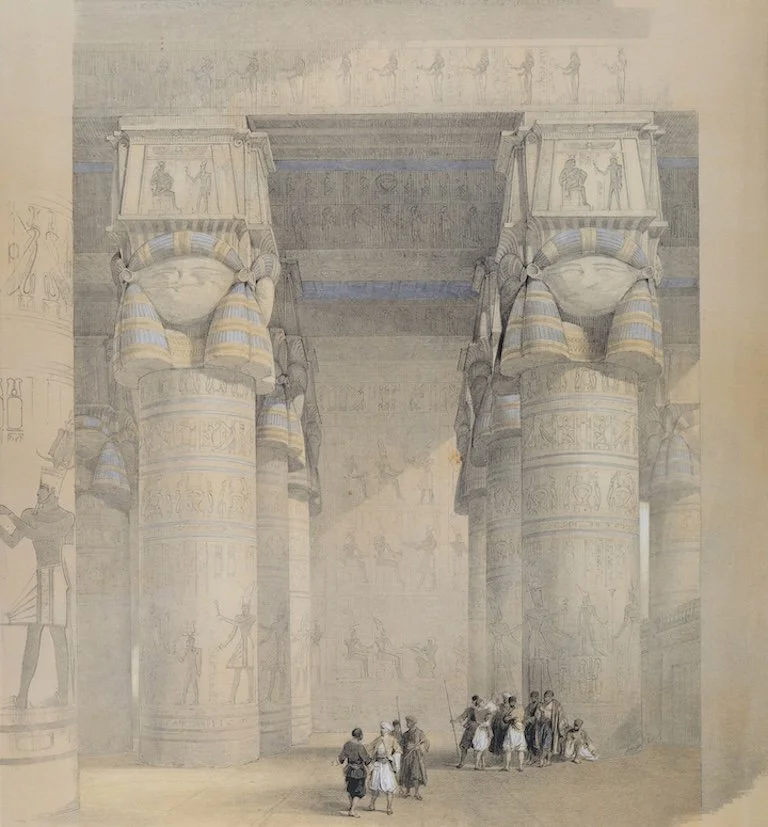 Image 3 of 5
 Image 4 of 5
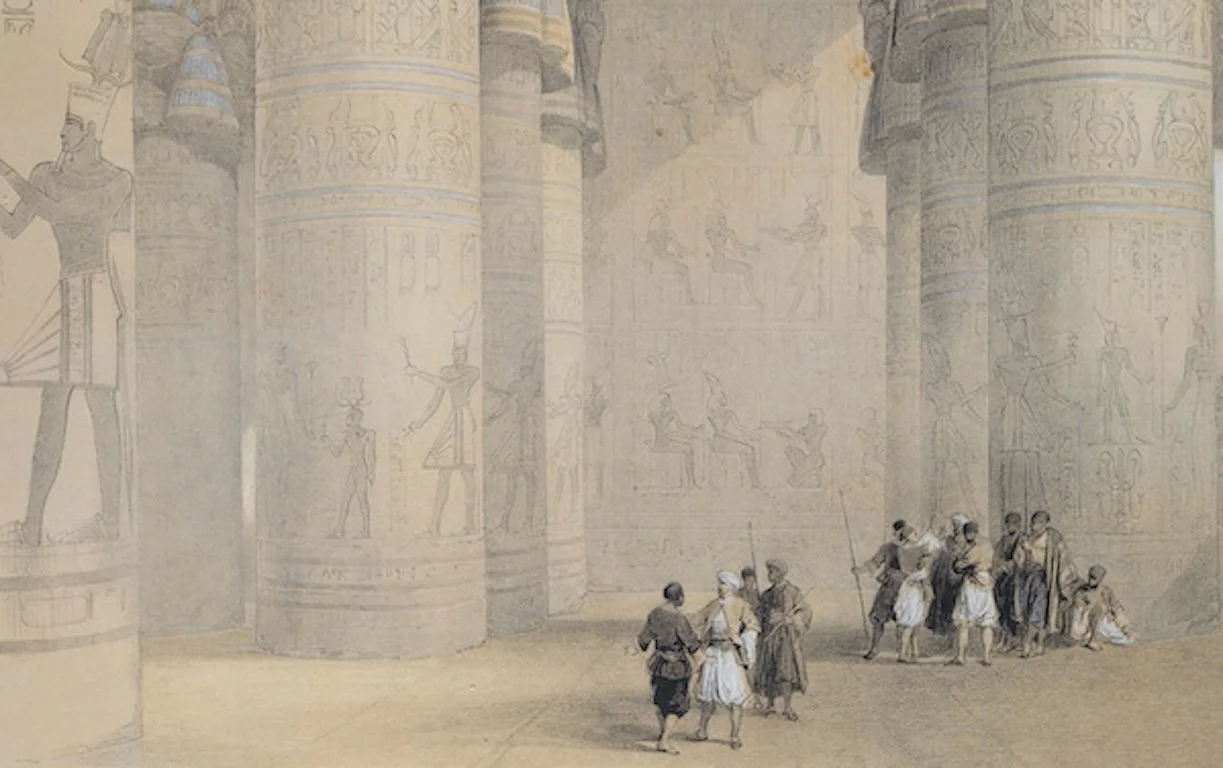 Image 5 of 5
This lithograph depicts the Temple of Hathor at Dendera from within its great hypostyle portico, emphasizing monumentality, shadow, and sacred atmosphere. The composition is dominated by massive stone columns arranged in deep perspective. Each column is crowned with the distinctive Hathoric capital, a carved face of the goddess Hathor beneath a splayed, square abacus, repeated rhythmically down the hall. Roberts carefully renders the dense covering of hieroglyphs and relief carvings that blanket the shafts, architraves, and ceiling beams, turning the architecture into a continuous surface of sacred text and imagery. Light enters from the open forecourt behind the viewer and from gaps between columns, creating a dramatic contrast between brilliant Egyptian sunlight and the cool, cavernous interior. This interplay of illumination and shadow heightens the sense of depth: the columns recede into darkness, suggesting vastness beyond the visible frame. Egyptian men stand (and one sits) near the base of the columns. Their small scale underscores the colossal proportions of the ancient structure and reinforces a romantic sense of awe before antiquity.
The Temple of Dendera, also known as the Temple of Hathor, located north of Luxor on the west bank of the Nile, is one of the best-preserved temple complexes in Egypt and holds major religious, artistic, and historical significance. The temple was dedicated primarily to Hathor, goddess of love and beauty, music and joy, motherhood and fertility, as well as the sky and cosmic order. Dendera was an important pilgrimage site in antiquity. Festivals celebrated Hathor’s union with Horus of Edfu, symbolizing divine harmony and renewal. The temple functioned not only as a place of worship but as a center for ritual, procession, and sacred performance.
This duotone lithograph is printed on a sheet with wide margins. Overall the sheet measures 23.88" high and 16.75" wide. The print is signed in plate in the lower right and titled in the lower left. There are two faint spots in the right margin and a faint vertical crease in the left margin. None of this would be visible behind a mat at framing. The image portion of the print is in excellent condition.
The drawings and watercolors from Roberts' tour of the Holy Land and Egypt were collated together into folios and released over a seven year period by the publisher F.G. Moon from 20 Threadneedle Street London. This lithograph is from the Royal Subscription Edition (1842-1849) with only 500 copies produced per depiction. Louis Haghe (the Belgian engraver and friend of Roberts) worked on all of the lithographs for this series.
David Roberts (1796-1864) was born outside of Edinburgh, Scotland. At age 10 he became a house painter’s apprentice. He continued painting houses and eventually theater scenes in Edinburgh and then in London. His friend, J. M. W. Turner, recognized his artistic talent and encouraged him to become a full-time artist.
In 1839 Roberts traveled to Egypt and then in 1840, through the Holy Land, concluding in Jerusalem. Upon his return to England, F. G. Moon agreed to publish lithographs created by Louis Haghe from Robert’s sketches and watercolors. This publication was highly acclaimed and very popular for its esthetic quality, its historical and topographical accuracy, and Robert’s dramatic depiction of his scenes. Queen Victoria and Charles Dickens were among the subscribers who collected his works. Roberts' and Haghe’s duotone lithographs, often colored, remain extremely sought-after today and have been rising steadily in value.