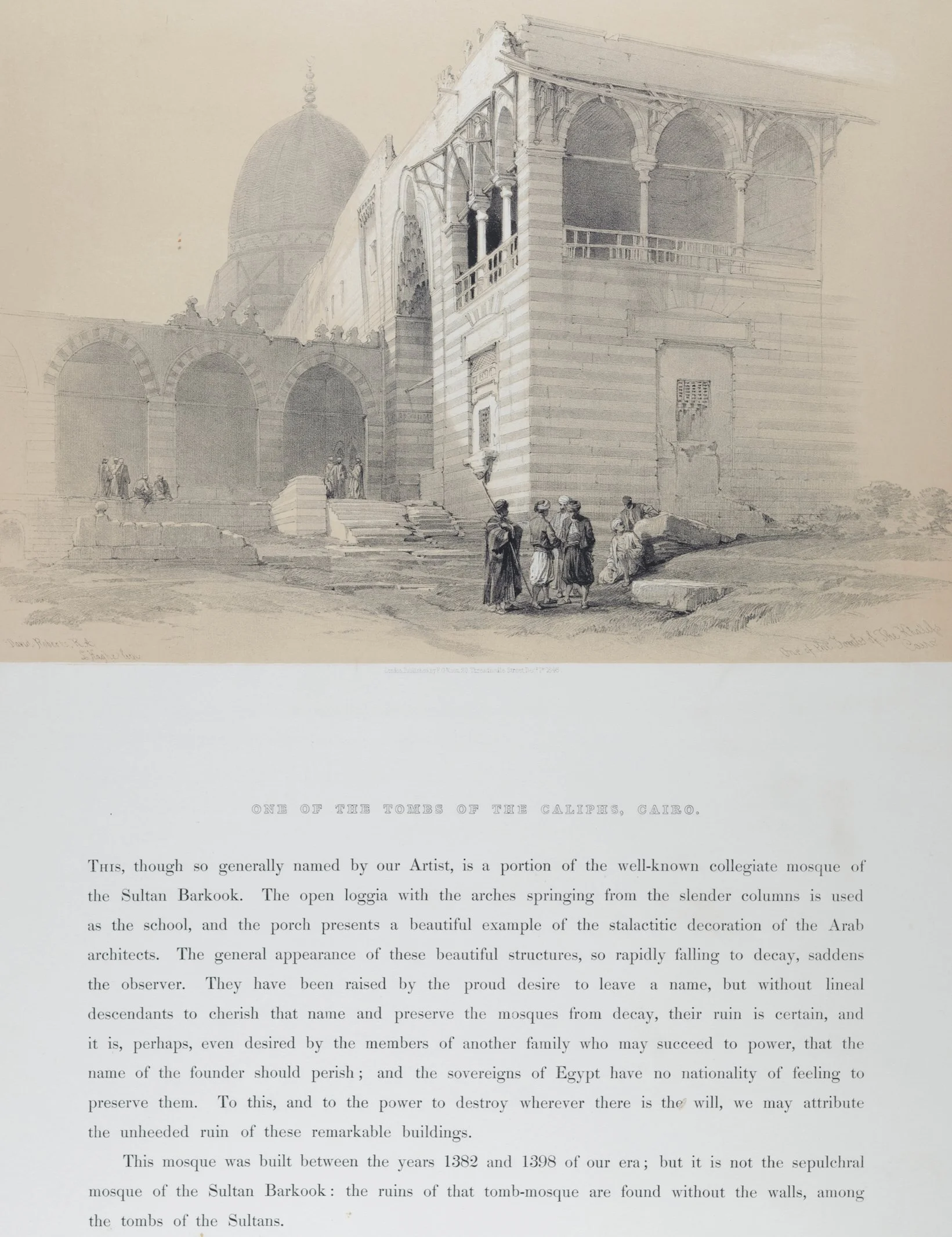
Image 1 of 4
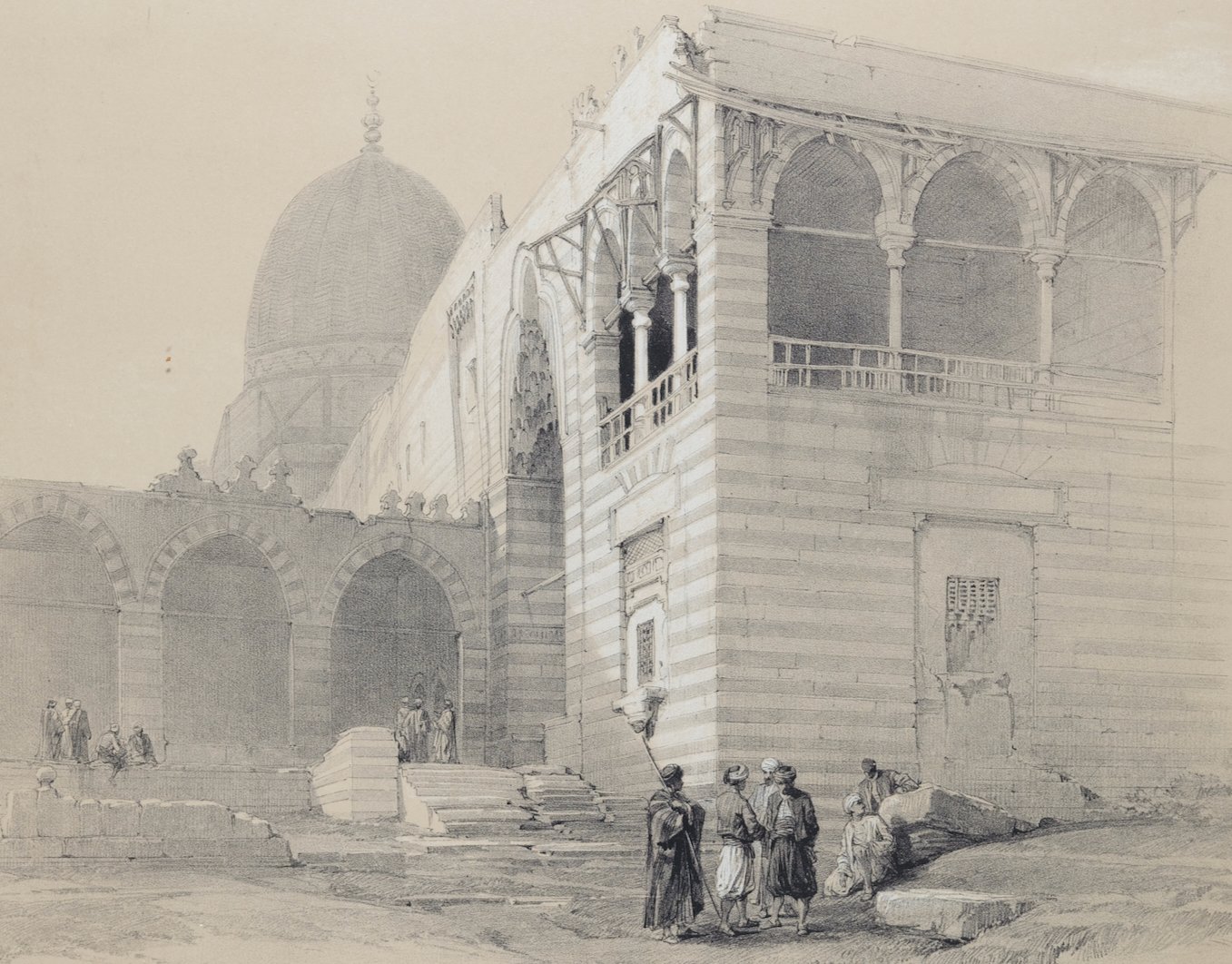
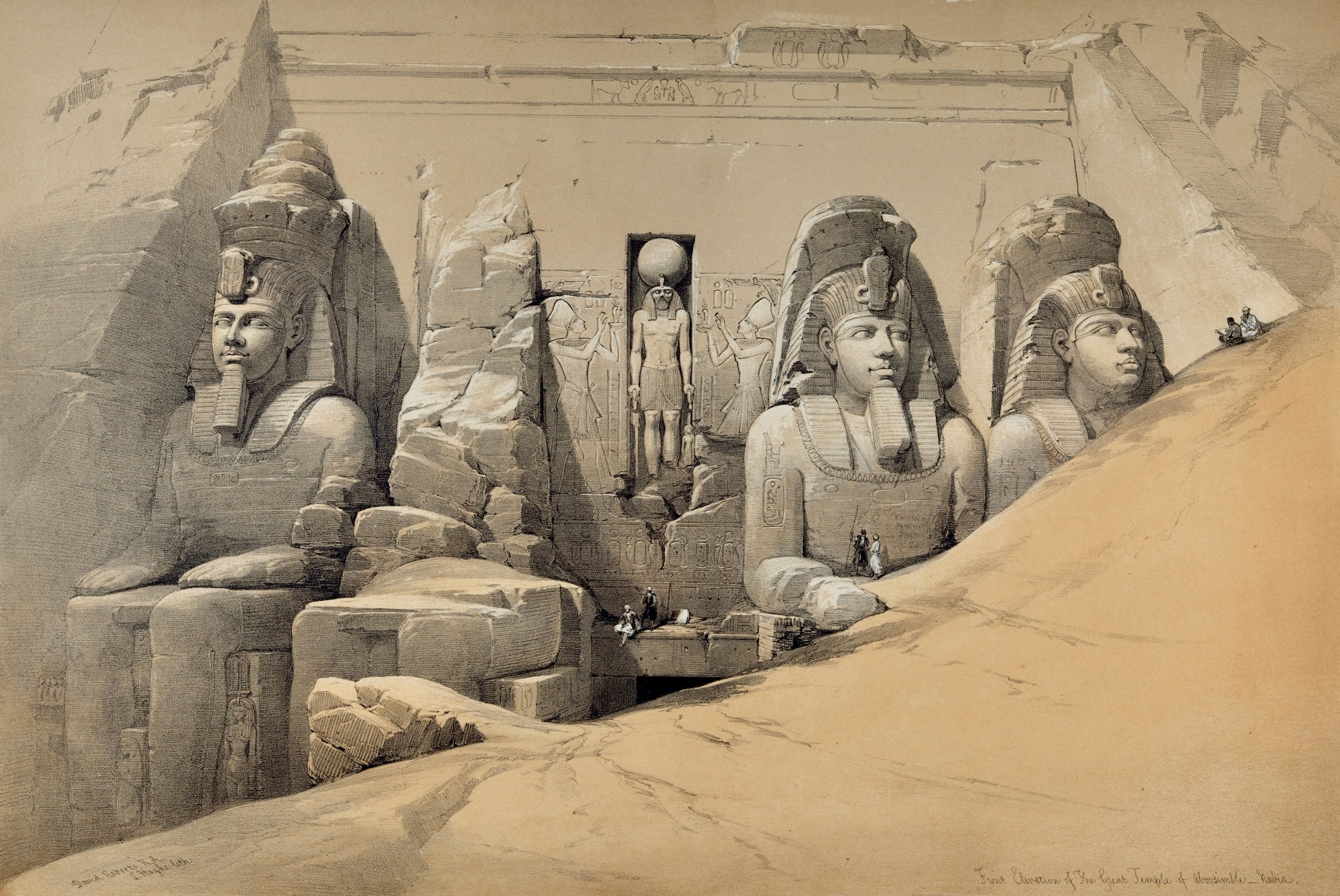 Image 2 of 4
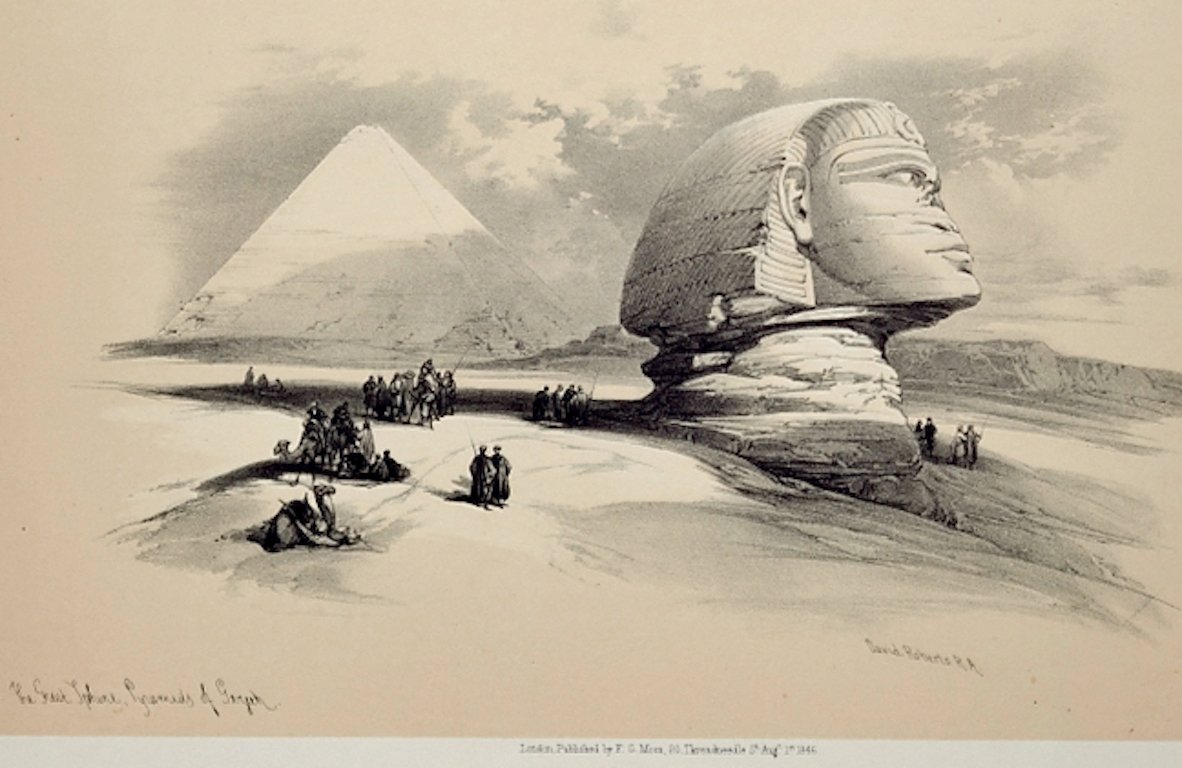
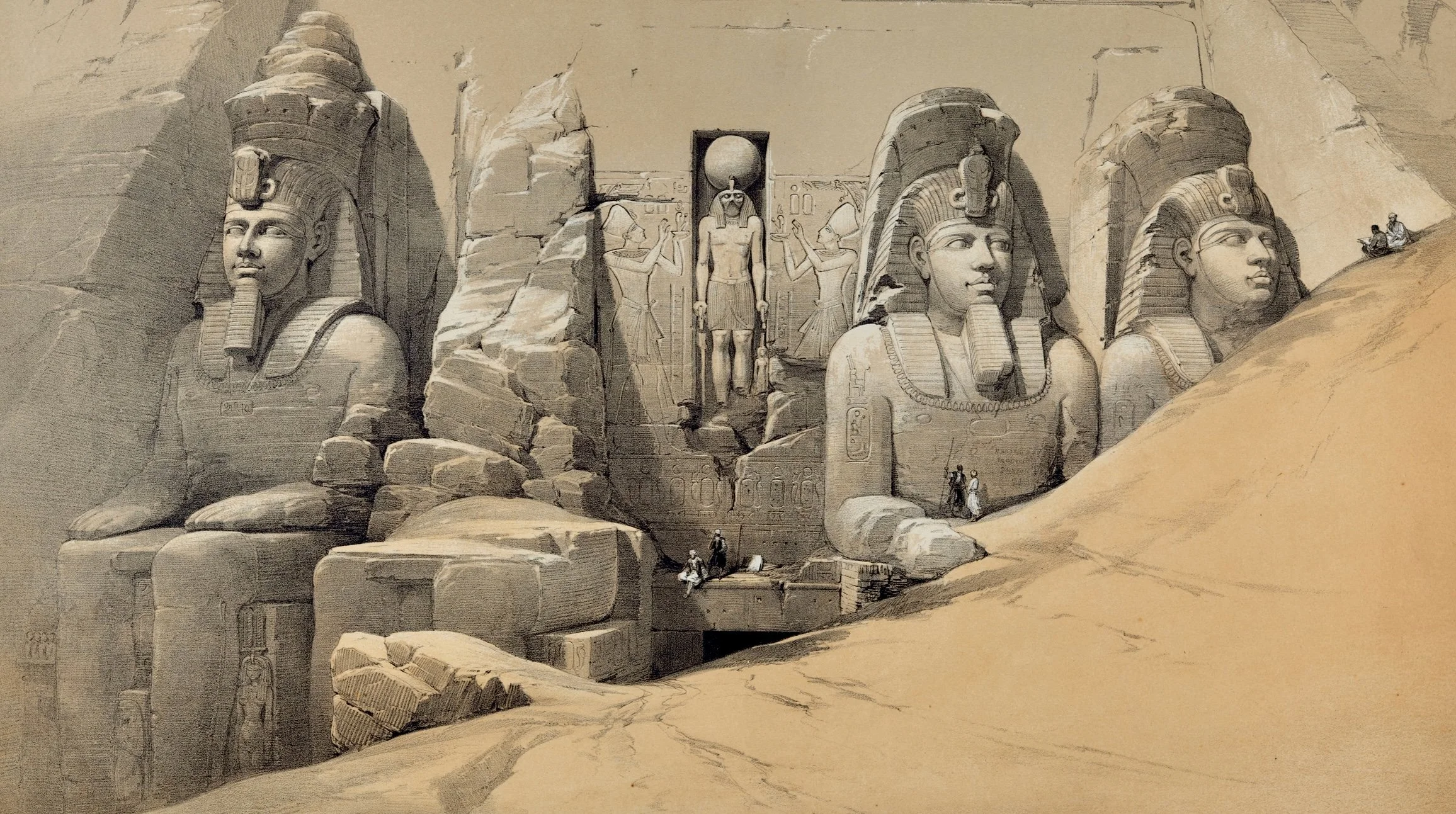 Image 3 of 4
 Image 4 of 4
This lithograph presents the façade of Abu Simbel with striking symmetry and monumental clarity. The composition is oriented towards the front and its architectural depiction is a precise drawing brought to life. Dominating the cliff face are the four colossal seated statues of Ramesses II, carved directly into the living rock. Roberts emphasizes their immense scale: each figure sits rigid and forward-facing, hands resting on knees, wearing the double crown of Upper and Lower Egypt. Their calm, impassive expressions convey authority and divine kingship. Between and beneath the colossal figures are smaller statues, members of the royal family, along with bands of carved relief and hieroglyphic inscriptions. Above the doorway runs a frieze of baboons, shown in adoration of the rising sun, reinforcing the temple’s solar associations. The entrance itself appears small and shadowed, receding into darkness, which heightens the overwhelming mass of the surrounding stone. Roberts includes Egyptian men around the base of the temple and sitting in the sand on the right, giving perspective to the immense size of the structure. Light in the lithograph is strong and directional, illuminating the warm sandstone while casting deep shadows that sharpen the sculptural forms. The overall effect is one of awe and stillness; architecture fused with landscape, power embedded in the cliff itself.
The Great Temple of Abu Simbel was built by Ramesses II (13th century BCE) in Nubia (southern Egypt, near today’s Sudanese border). It functioned as a display of imperial dominance and a statement of Egyptian control over Nubia, as well as a proclamation of Ramesses’ semi-divine status. The colossal statues act as political propaganda in stone. The temple was dedicated to the gods Amun-Ra, Ra-Horakhty, Ptah, and the deified Ramesses II. Twice a year, the rising sun penetrates the temple’s inner sanctuary, illuminating statues of the gods inside the structure; an extraordinary alignment that reinforces the temple’s cosmic and solar symbolism.
In the 1960s, the temple was threatened by flooding due to the construction of the Aswan High Dam. In an unprecedented international effort led by UNESCO, the entire temple was cut into blocks and relocated to higher ground (1964–1968). This rescue became a landmark in global heritage preservation.
This duotone lithograph is printed on a sheet with wide margins. Overall the sheet measures 16.75" high and 23.88" wide. The print is signed in plate in the lower left and titled in the lower right. There is discoloration and small areas of paper loss along the upper edge, a small tear of the lower edge on the left, a tiny spot at the edge of the right margin and a faint horizontal crease in the upper margin. None of this would be visible behind a mat at framing. The image is in excellent condition.
The drawings and watercolors from Roberts' tour of the Holy Land and Egypt were collated together into folios and released over a seven year period by the publisher F.G. Moon from 20 Threadneedle Street London. This lithograph is from the Royal Subscription Edition (1842-1849) with only 500 copies produced per depiction. Louis Haghe (the Belgian engraver and friend of Roberts) worked on all of the lithographs for this series.
David Roberts (1796-1864) was born outside of Edinburgh, Scotland. At age 10 he became a house painter’s apprentice. He continued painting houses and eventually theater scenes in Edinburgh and then in London. His friend, J. M. W. Turner, recognized his artistic talent and encouraged him to become a full-time artist.
In 1839 Roberts traveled to Egypt and then in 1840, through the Holy Land, concluding in Jerusalem. Upon his return to England, F. G. Moon agreed to publish lithographs created by Louis Haghe from Robert’s sketches and watercolors. This publication was highly acclaimed and very popular for its esthetic quality, its historical and topographical accuracy, and Robert’s dramatic depiction of his scenes. Queen Victoria and Charles Dickens were among the subscribers who collected his works. Roberts' and Haghe’s duotone lithographs, often colored, remain extremely sought-after today and have been rising steadily in value.