 Image 1 of 3
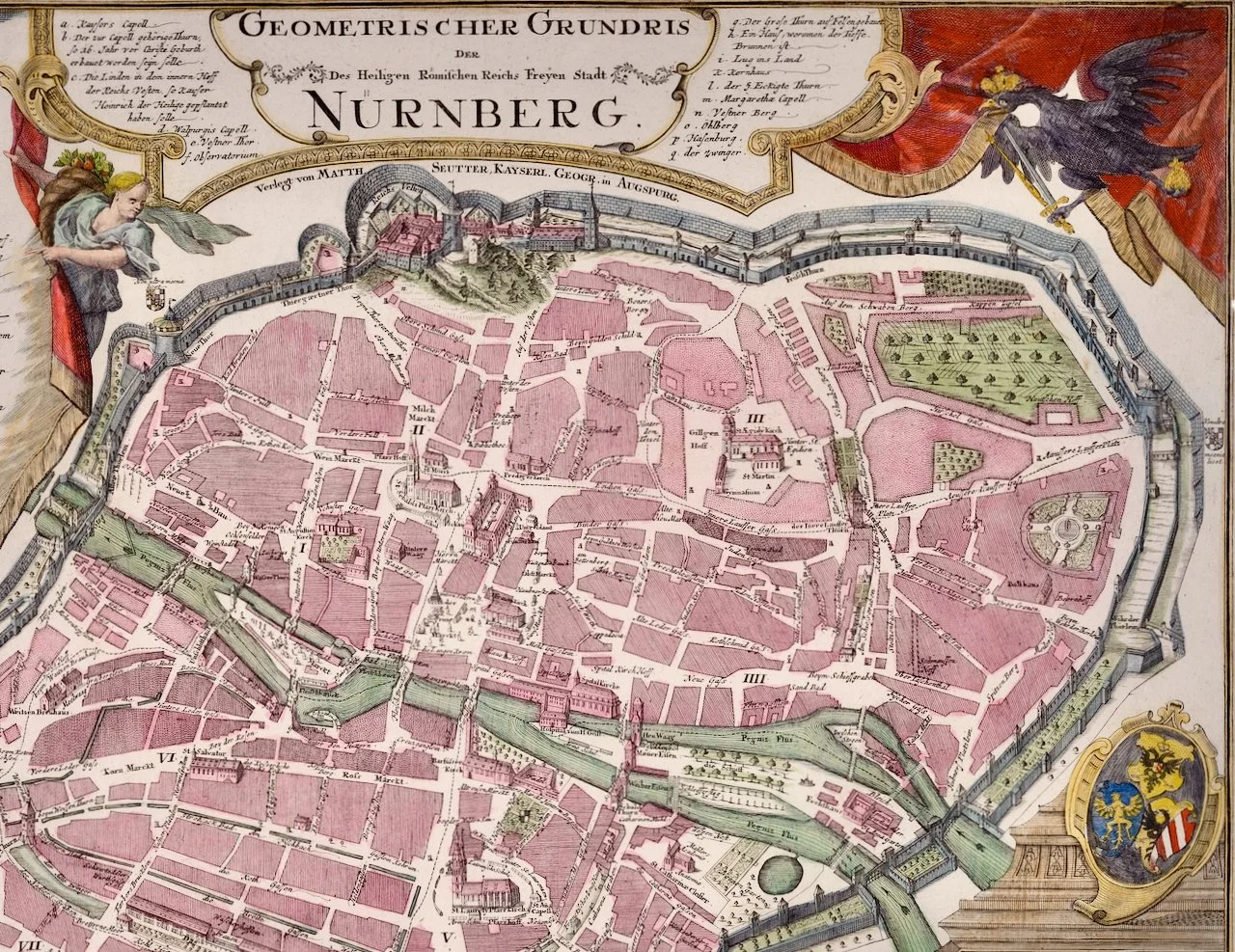 Image 2 of 3
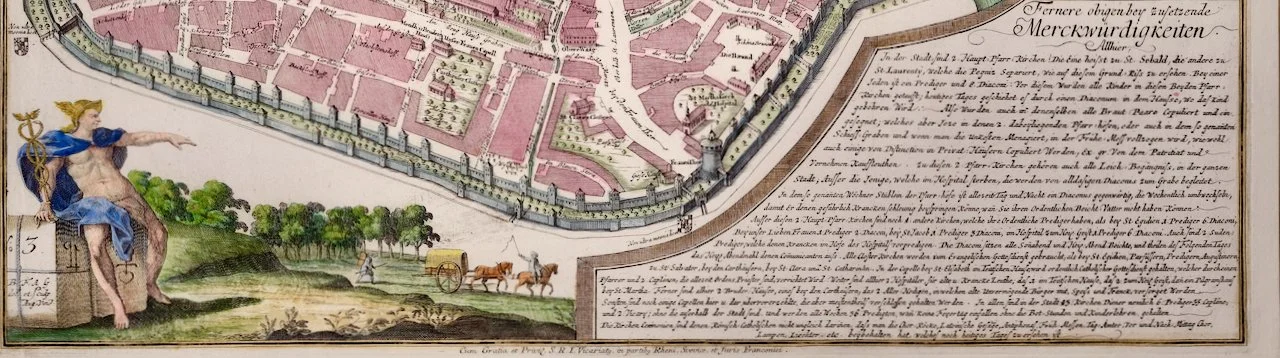 Image 3 of 3
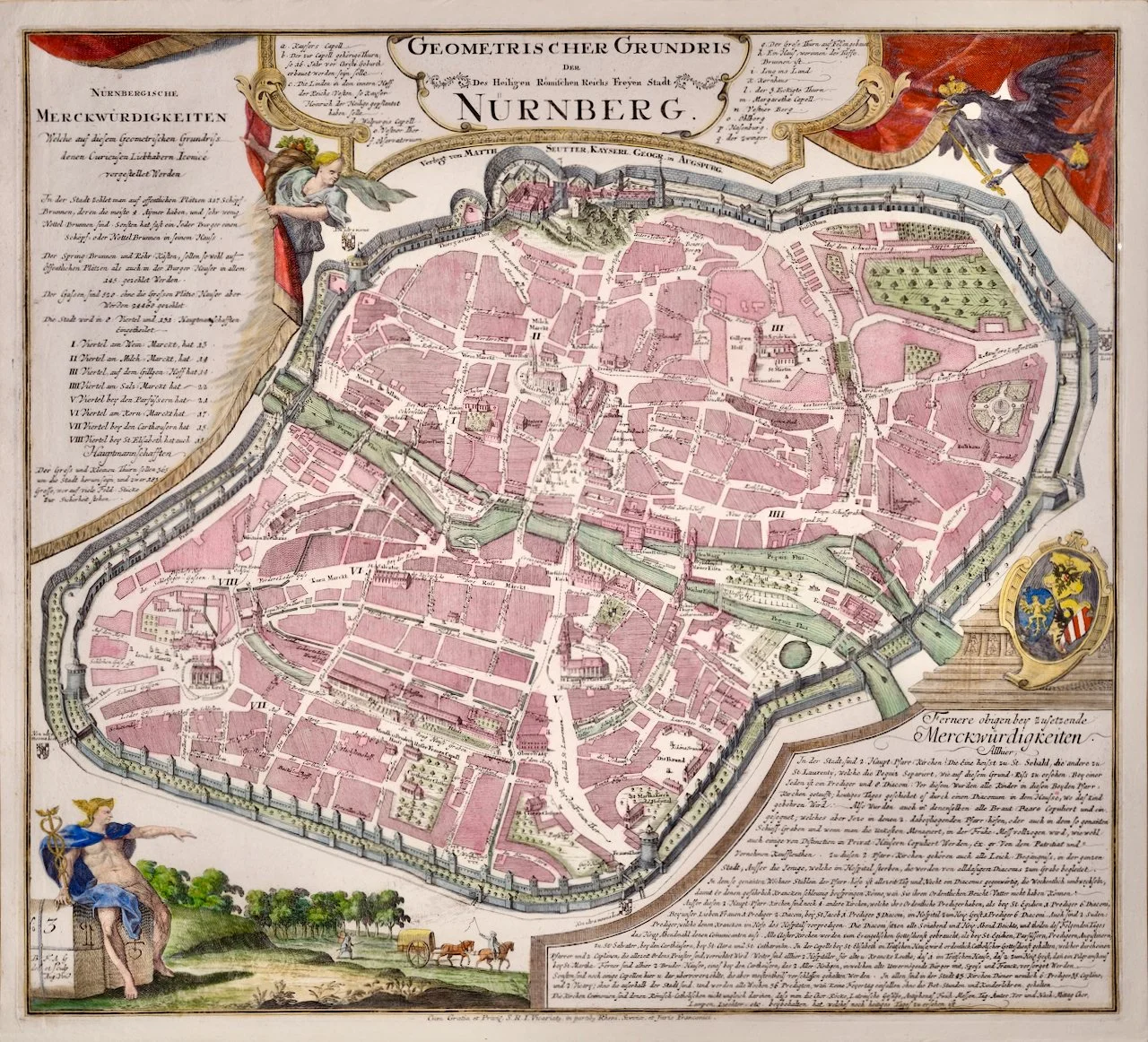
This beautiful and colorful plan of the city of Nuremberg depicts the city walls and ramparts, as well as buildings and streets in great detail. Buildings, including churches, administration buildings and Nuremburg Castle are numbered and named in accompanying legends. The artistic title cartouche is located in the upper center, with a figure on the left and an eagle on the right, wearing a crown and holding a royal scepter, sword and the royal apple topped by a cross. The crown, sword and apple are highlighted in gold. An engraved depiction of Mercury sitting on a mileage marker is in the lower left. He is waving to a passing rider leading a horse drawn cart, who waves back. His helmut and sceptor are highlighted in gold. A large coat of arms is present on the right and four small coat-of-arms are placed just beyond the city walls. A prominent area of German text occupies the lower right corner.
This large colorful copper-plate hand-colored map is printed on thick chain-linked paper with wide margins. The margins may have been previously professionally reinforced on the verso and the center fold smoothed. The sheet measures 22" high and 24.25" wide. The map is in excellent condition.
Matthäus Seutter (1685-1757) was the son of a goldsmith in Augsburg, Germany. He studied in Nuremberg and following his schooling, was apprenticed as a brewer. Realizing that his future was elsewhere, he moved to Nuremberg where he became an apprentice engraver to the prominent publisher and cartographer Johann Baptiste Homann. Upon returning to Augsburg, he started his own publishing firm in 1710, creating maps, atlases, and globes. By 1732, Seutter was one of the most prolific publishers of his era and was given the title of “Imperial Geographer” to the German Emperor Charles VI. Seutter's most well-known works are the "Atlas Geographicus oder Accurate Vorstellung der ganzen Welt" (Geographical Atlas or an Accurate Depiction of the Whole World) in 1725, "Grosser Atlas" (Large Atlas) in the 1734, and "Atlas Minor" (Small Atlas) in 1744. Following his death in 1757 his son Albrecht Karl, his son-in-law Conrad Tobias Lotter, and his business partner Johann Michael Probst ran the printing business.